Case Study 02 · 2025
duel.
A social feature concept for Duolingo — designed to turn daily practice into a friendly rivalry.
A self-initiated case study exploring how 1:1 challenges, streak scoring, and celebratory feedback could deepen long-term engagement inside an already gamified learning app.

Product Design
Feature Concept
Mobile · iOS
Self-Initiated
Experiment Design



Focus
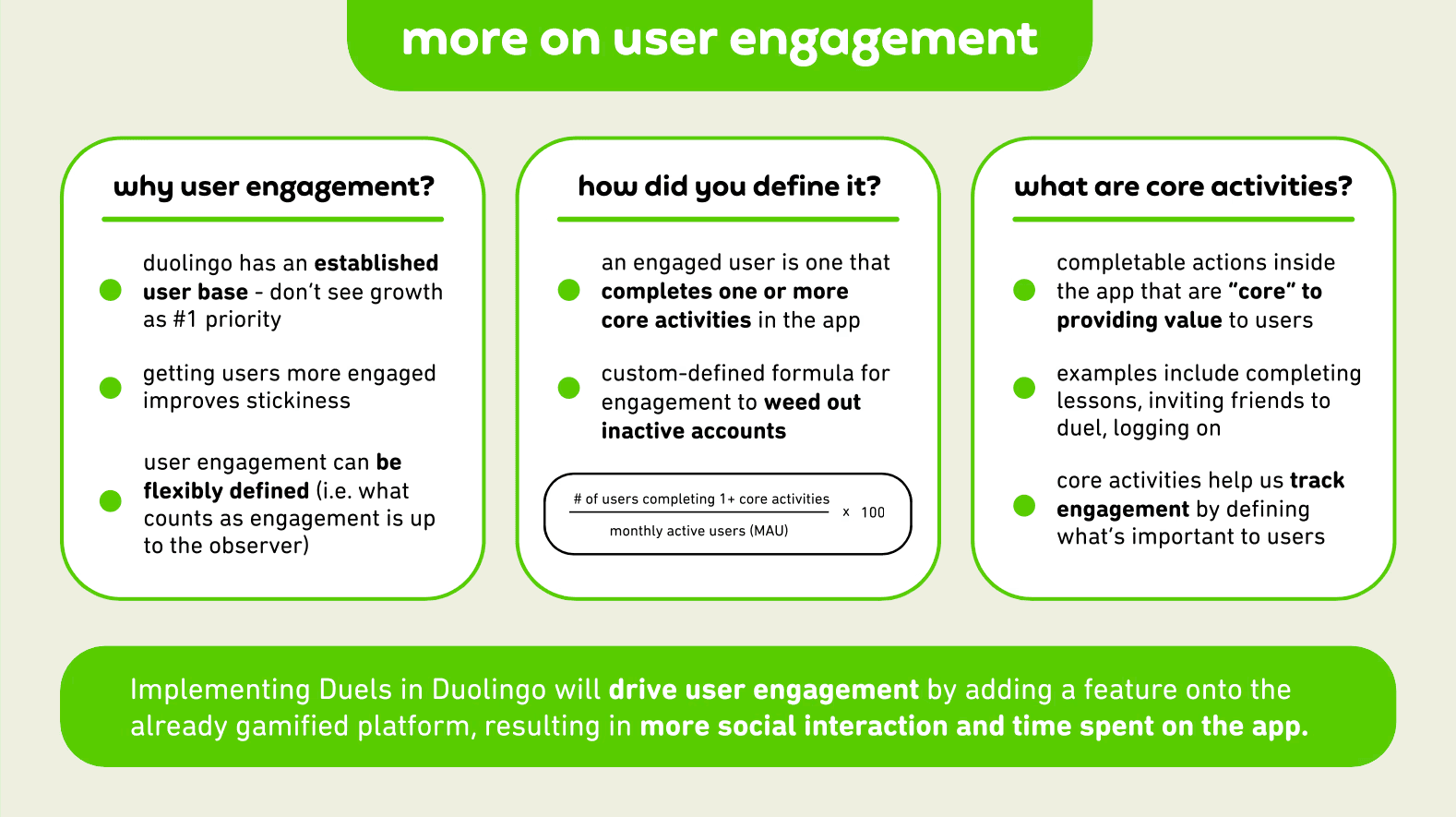
Engagement
Retention · Social play
ROLE
Solo Designer
Self-initiated project
Timeline
1 month
2025, personal sprint
Tools
Figma
Hi-fi flows & prototypes

—— Competitive & Behavior Insight ——
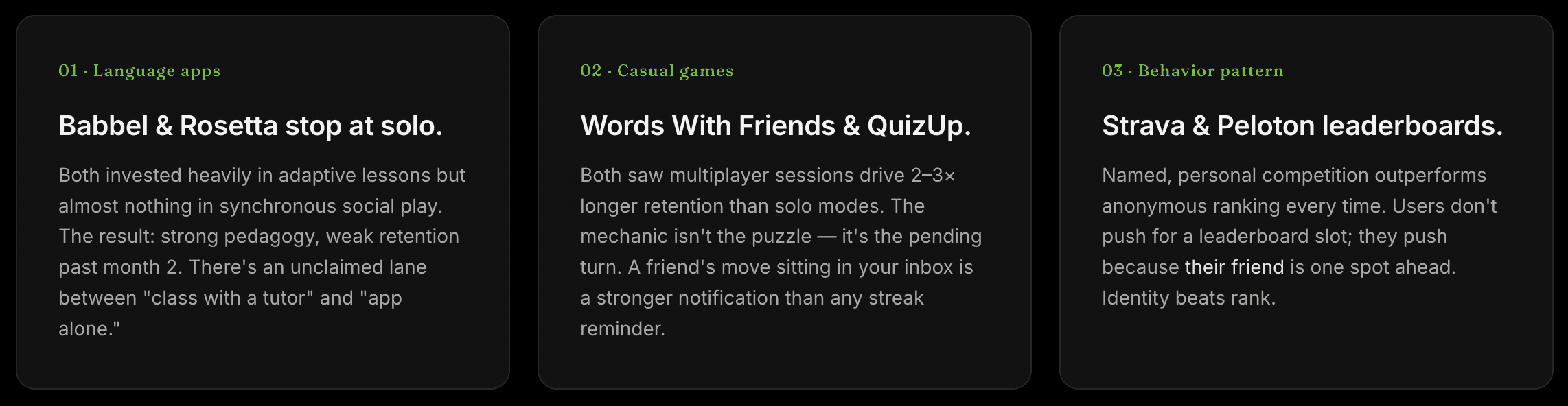
Why 1:1 competition works — and where similar apps stop short.
I looked at three categories to understand what a duel-style feature actually does to behavior: language apps, casual mobile games, and social fitness apps. The pattern was consistent.

Feature summary slide from the concept deck — flow overview and edge-case matrix.
—— Flow ——
Five screens, one continuous loop.
The whole feature had to fit inside behaviors Duolingo users already have. No new tab, no new mental model — just a new button in a place they already visit.


—— Iterations
From four competing invite models to one that felt like Duolingo.
Early sketches leaned too far in two directions — either too game-like (looked like Words With Friends) or too utilitarian (looked like a settings screen). Three rounds of iteration landed on something that reads as Duolingo first, competition second.
—— Final Interaction ——
The moment the feature earns its keep — the streak celebration.
The core interaction I optimized for wasn't the invite or the result — it was the mid-round streak moment, when the user has answered 3–5 correctly in a row. That's where a solo lesson becomes a duel.
KEY MOMENT
Profile-level integration
The DUEL button lives in the exact spot users already tap to follow someone — no new mental model. Statistics like day streak, XP, and Achievements stay in place; the feature slots in rather than reorganizing the profile.
Reward without punishment
Winners earn bonus gems; losers still earn XP for participation. Streaks are protected on both sides. The feature adds an upside to social play without introducing a downside to opening the app.
—— Testing Plan ——
How I'd validate this before shipping.
A concept is only as good as the plan to disprove it. I designed a two-stage validation approach: qualitative interviews with high-fidelity prototypes first, then a randomized A/B test at MVP.


Full validation methodology — interview questions, sample logistics, and success metrics.
—— Success Metrics ——
What "working" would look like.
Directional targets I’d use to evaluate the experimental arm. These are proposed thresholds for the concept, not results from a live test.

—— Roadmap ——
A hypothetical delivery roadmap.
A five-stage delivery plan based on publicly documented product experimentation practices at Duolingo — PRD in hand, wireframes reviewed cross-functionally, MVP live, then iterate on measured results. I have not worked inside Duolingo; this is a hypothetical roadmap, not a description of their internal process.

End-to-end delivery timeline shared with a hypothetical Duolingo engineering team.
—— Feature Definition ——
Introducing Duel — an asynchronous 1:1 challenge inside Duolingo.
A duel is a short, lesson-based head-to-head between two friends. It runs asynchronously, avoiding the complexity of real-time matchmaking while allowing both players to complete the challenge on their own schedules. Streak-based multipliers and celebratory feedback keep the experience engaging, whether the player wins or loses.